Smarter Roads, Part 4: The Detection Gap

Most road failures don’t start with a bang.
They start with silence, a defect forming long before anyone sees it.
In Part 2, we explored the scale of Australia’s road network. In Part 3, we looked at how road defects form and escalate. Now we arrive at the core challenge: why do we still find defects so late?
This chapter is about the detection gap, the space between when a defect forms and when it is actually found. It is the blind spot that turns small problems into big ones.
And today, most defects stay invisible until they have already failed.
How Detection Works Today
Most councils still rely on a mix of:
- scheduled network‑wide inspections (often every 3 to 5 years) and periodic operational inspections that may occur quarterly or monthly [1].
- visual drive-throughs by maintenance crews
- resident reports via call centres or apps
- on-the-job observations by council workers
These methods are:
- infrequent
- labour-intensive
- subjective
- reactive
As Transport for NSW notes, “traditional road audits are infrequent, time-consuming, and expensive,” often leaving councils to focus on reactive repairs rather than early intervention [1].
Why This Creates a Gap
The problem isn’t that people don’t care. It is that the system isn’t designed for continuous visibility.
A crack that forms on Monday might not be seen until the next quarterly inspection, long after it has become a pothole.
By the time a defect is reported:
- it has already grown
- it is already a safety risk
- it is already more expensive to fix
This is the detection gap, the time between when a defect forms and when it is finally found.
Shrink the gap, and everything else gets easier.
The Cost of the Gap
According to Noosa Council, potholes and broken pathways account for nearly 40% of resident calls, a significant drain on council time and public trust [2].
Every missed defect means:
- higher repair costs
- more downtime
- more disruption
- more risk
And without consistent data, councils can’t:
- prioritise repairs by severity
- allocate crews efficiently
- plan long-term maintenance
- measure the impact of interventions
What’s Changing: AI and Continuous Sensing
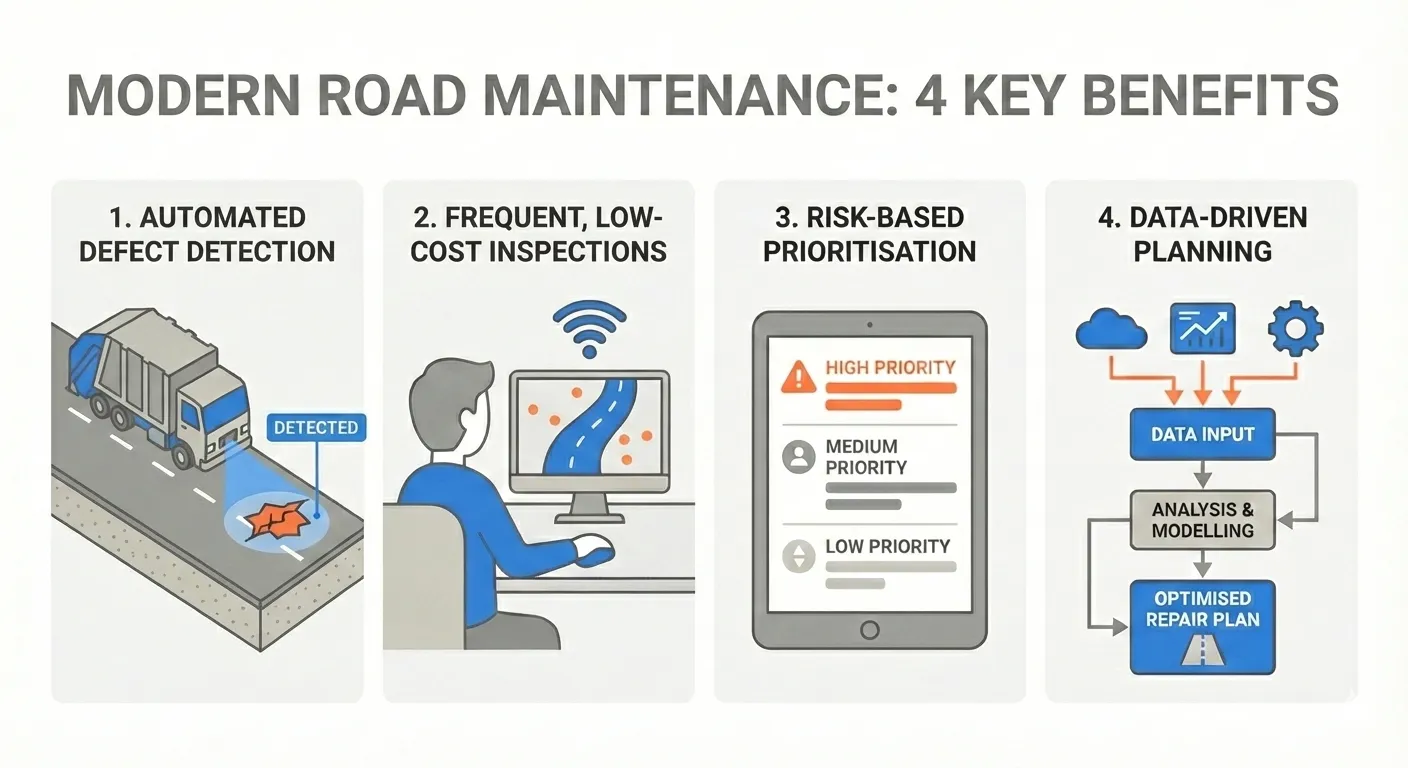
New tools are starting to close the gap.
Projects like Asset AI, developed by Transport for NSW, use:
- vehicle-mounted cameras
- AI-powered image analysis
- sensor data from council fleets
This enables:
- frequent, low-cost inspections
- automated defect detection
- risk-based prioritisation
- data-driven planning
Noosa Council is already piloting this approach with TechnologyOne, using AI and machine learning to monitor roads and footpaths across the region [2].
Why This Matters for the Project
These initiatives show how far the sector has come.
Councils are already using AI to detect defects more often, at lower cost, and with far greater consistency than traditional inspections [3].
Our project builds on this momentum, not by replacing existing systems, but by expanding what’s possible.
We’re exploring two key opportunities:
- LiDAR for richer surface data, capturing geometry and deformation that RGB cameras miss
- Open source object detection, enabling low‑cost, decentralised sensing on everyday devices
Together, these tools point toward a more adaptive sensing ecosystem, one that’s easier to deploy, easier to share, and better at catching the early signals of deterioration.
Next, we’ll map the solution space:
What kinds of sensors, models, and workflows can help councils close the detection gap?
References
- Asset AI: Transport for NSW Case Study - Transport for NSW, 2025
- Council Supercharges Road Safety Using AI - LG Focus, 2025
- How Councils Use AI for Predictive Road Maintenance - Stewart Media Research, 2025